Meaning
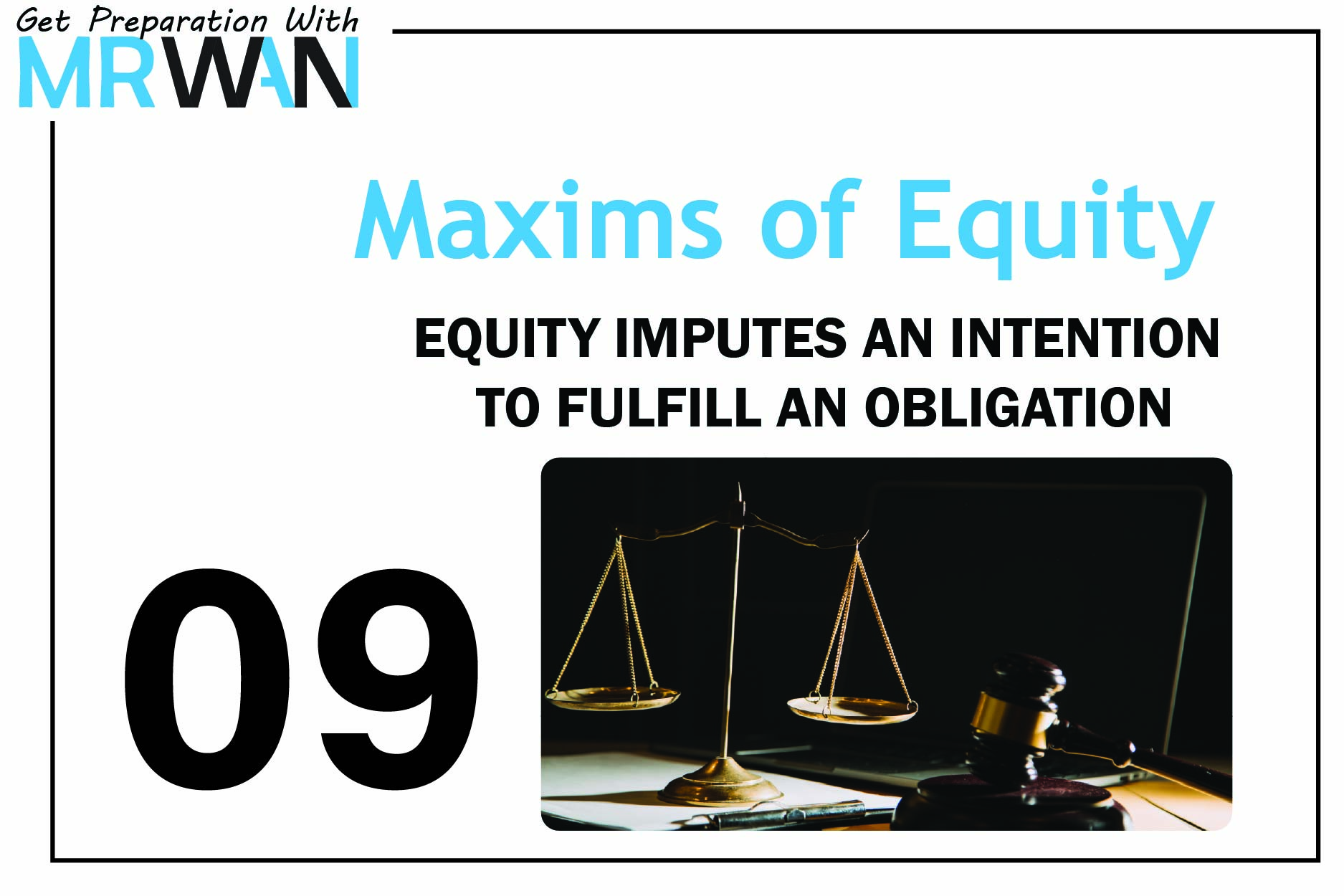
If someone undertakes an obligation for the other, equity courts look on it as done and as producing the same results as if the obligation had been actually performed. Equity courts therefore look to the acts of the person bound by his conscience and interpret and construe them in such a way that they amount to what ought to be done.
Thank you for reading this post, don't forget to subscribe!Application and cases
If A makes T trustee leaving 50,000 Taka to purchase a land for the use of B. T does not purchase the land and by the time, B dies leaving all immovable property to X and all movable property to
- Now, who should get the 50,000 Taka? Equity in such cases would definitely regard the purchase of land which ought to have been made as made. The money thus goes to X.
The working of this maxim can be seen-
- i) The doctrine of conversion
- ii) Executory contracts
iii) Doctrine of part performance
i) Doctrine of conversion-
In the case of Lachmere v. Lady Lachmere, money was taken as land. Doctrine of conversion can convert the money into immovable property and immovable property into money.
ii) Executory contracts-
(a) Assignment of future property: When an assignment of property was made for consideration equity treated it as a contract to assign. When the property came into existence in such a contract, it was treated as a complete assignment. As a leading case on this point, Holroyd v. Marshall can be cited.
(b) Agreement for a transfer: In Walsh v. Lonsdale, it was decided that an agreement for lease could be treated as a lease in equity.
iii) Doctrine of part performance: Under the equitable doctrine of part performance contracts pertaining to land were allowed to be formed by oral evidence where one of the parties did acts of pats performance. Maddison v. Alderson is a leading case on this point.
Essential requirements:
- There should be a contract to transfer the legal title.
- There must be a substantial evidence to prove the existence of that contract.
- This contract should be capable to enforce.
- The suit must be brought by the parties within the specific time.
- The title so sought to obtain must have legal support.
For Articles Notification join the whatsapp channel.