Introduction:
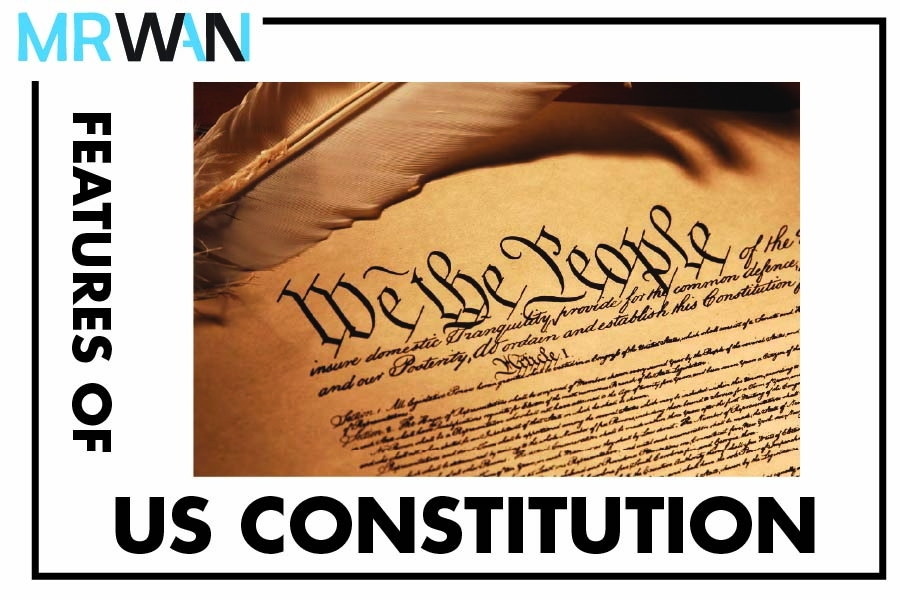
- It is the oldest written constitution in the world
- The Declaration of Independence of 4th July 1776 was the first formal State Paper – it is here that the term United States was for the first time officially used.
- The constitution was drafted by the Philadelphia Convention on Sept. 17, 1787.
- It was adopted by the Congress of the Confederation in 1788, and was finally put in to effect in 4th March, 1789.
- Salient features of the constitution can be listed as follows.
Features:
- A Written constitution,
- Popular Sovereignty,
- Limited Government,
- Separation of powers,
- Checks and Balances,
- Presidential form of Government,
- Federal system of government,
- Bill of Rights,
- Dual Citizenship,
- Supremacy of the Constitution,
- A Rigid constitution,
- Judicial Review,
- A Secular State,
- A Democratic government,
- A Bicameral Legislature,
- Conspicuous Omissions, etc.
A written Constitution
- It is the oldest, briefest written constitution in the world.
- It consist of a Preamble & 7 Articles running into 4000 words with 10 to 12 pages to be read within half an hour.
- It has also unwritten elements like Conventions.
- Statutes of the Congress, judicial decisions and executive decrees also enlarged the Constitution.
Popular Sovereignty:
- It recognizes popular sovereignty wherein supreme power belongs to people.
- Preamble of the constitution affirms this – the government derives their just powers from the consent of the governed.
- People are the source of all powers.
- When a government fails in its duty people can remove that government.
- It means the right of the people to control the government.
Limited Government:
- A constitutional government means a limited government – there are specific limits on the powers of the government.
- Limited governments are necessary for safeguarding the rights of the citizens from autocratic rule of the government.
- The constitution granted limited powers to the national government and left the remaining powers to the state.
- Even the state governments are not unlimited powers, their powers are only remaining.
- The constitution asserts the rights of the people & limits the authority of the government.
Separation of powers:
- It was the first constitution to implement this theory.
- This theory aims at the prevention of concentration of powers so as to ensure the liberty of the individual.
- All powers of the government should not be concentrated in a person or assembly of persons.
- In the US, the three functions of the government are entrusted to the 3 distinct branches of the government – Congress, President & Supreme Court.
- The 3 branches of the government are independent of one another & not allowed to interfere with others affairs.
- For example, President is elected independently of the Congress & the President cannot dissolve the Congress & the judges cannot be removed by the president.
Checks and Balances:
- The idea of checks and balances are provided so as to promote unity and equilibrium in its functions.
- No branch of the government is allowed to act autocratically.
- It enables each branch to act as a break so as to avoid accidents or frictions.
- No branch of the government can abuse powers and act despotically beyond certain limits – so power must be checked by power.
- For example, the Congress may impeach the president and judges, or without the Senate’s approval the appointments made by the president cannot put into effect, president can veto the bills passed by the Congress, likewise, the Supreme Court can declare a law passed by the Congress invalid.
Presidential form of Government:
- It provides for a presidential form of government.
- There is only one executive – the president.
- The president is neither elected by the Congress nor responsible to it.
- There is no close relationship between the congress and the president.
- President cannot dissolve the congress.
- This system of government functioning on the basis of the theory of separation of powers.
- President’s secretariat or Cabinet do not belongs to the congress.
- President is the head of the nation & all executive powers are vested in his name. he enjoys a fixed tenure of 4 years.
Federal system of government:
- It is the first constitution which adopted a federal system of government
- It is a system of government that divides power between a central government having authority over the entire country and a series of local governments collectively covering the entire territory.
- In a true federal system the two levels of government must be more or less independent of the other
- The constitution of USA is a indestructible union with indestructible states.
- National government is given charge of matters of national importance & the subjects of local importance are taken care of by the state governments.
- Both the governments derive their powers straight from the constitution.
- In the US federation residuary powers are vested with the state governments. It is a federation of 50 states.
- It is the most perfect of the federal constitutions. (C.F.Strong)
Bill of Rights:
- The original constitution did not contain a bill of rights.
- But the first 10 amendments passed within the first 2 years of its inauguration, provided for a Bill of Rights.
- It contained the following rights,
- Freedom of religion,
- Freedom of speech & expression,
- Freedom of assembly and petition,
- Right to keep & bear arms for security,
- Freedom of profession,
- Right to private property,
- Right to legal equality,
- Right of voting irrespective of their color, race or sex,
- No person can be compelled to be a witness against himself,
- No person can be deprived of his life, liberty or property without the due process of law,
- Slavery should be abolished,
- No property can be taken for public use without just compensation,
- The right to speedy & public trial by an impartial judiciary,
- No state shall make or enforce laws which abridges the privileges and immunities of the citizens of USA. } These rights & liberties are not absolute, it can be modified only with an amendment to the constitution, and these rights are enforceable in the courts of law.
Dual Citizenship:
- Citizens are those who possess full membership of the state & those who enjoy political rights in a state are its citizens.
- The concept of citizenship was not defined in the original constitution.
- The 14th Amendment Act, clearly provided for double citizenship.
- Citizenship of the USA and the citizenship of respective state in which one resides are the double citizenship an individual enjoys in USA.
- Only citizens of the state can contest for elective or public offices in the state. He can also contest for federal offices only from the state of which he is a citizen.